Thursday, April 18, 2013

Mei Ban Fa

My friend Jess's favorite Chinese phrase is mei ban fa.  It means "my hands are tied," or  "it can't be done."  This is the perfect phrase to describe my work as an English teacher.
I have been planning this blog post in my head ever since I arrived in China and started thinking about the Chinese education system, but I wanted it to be perfect which is what has taken so long.  There is so much I want to say about how education works here and how it works at home, and how the two systems are both kind of broken and could both learn a lot from each other.  I just want to say, as a disclaimer, these are all my own opinions, based on my experience here and conversations I've had with Chinese and foreign teachers, and not necessarily the experience of every Chinese student and teacher. 
The first thing you need to understand about the Chinese education system is that it is test based.  Students must pass exams to enter each level of school, and their scores on these exams can determine their future.  Unlike in the US, Chinese students are accepted to university (and middle school, and high school) based entirely on their test scores.  There is no interview, no essay, no consideration of extracurriculars or part-time jobs.  Time spent on sports teams or art or dance is considered a waste of time by many, unlike in the US where extracurricular activities are coveted collector items.   Exams determine which students go to the best middle schools and high schools and universities, and much like in the US, students from the best universities have the best job opportunities later.  And when you are one of 1.3 billion people, every advantage you can get to stand out is desperately sought after.  The result of this system is a lot of stress on students, even very young students like my first and second graders. 
There are other things at play here.  The exam system is only the most obvious manifestation of a system that values memorization and correct answers over creativity and individuality.  Chinese students are expected to be quiet and well-behaved.  They don't like to volunteer answers in class if they might be wrong.  They are not taught to ask why and they are not asked open-ended questions with multiple right answers.
 In one of the many conversations about education I've had with my friend and co-teacher, Ada, she lamented the lack of creativity in Chinese students.  She said that everyone from teachers to government officials wants Chinese students to be more creative, but that none of them know how to teach creativity and innovation.  While in the US teachers and parents and news organizations lament the US's low test scores, Chinese teachers wonder how they can make their classroom more creative and open-minded.  While the US cuts funding for art, music and drama programs, teachers and officials in China worry that their students don't know how to be innovative.  They know that China is good at producing things, but they worry that all of the ideas are still coming from the US and Europe. It's a classic case of the grass is always greener.  We want China's super high test scores in math and science.  They want our creativity.
Some of my second graders performing "The Three Little Pigs"
 When I started teaching in September, I had no idea what I was doing.  Other than an online TEFL course and a few hours of observation, I didn't know anything about teaching.  At first all I wanted was to keep the students somewhat engaged or interested, but after I had a few conversations with Ada about the limitations and faults of the education system, my goals for my classes changed.  I got into a heated argument with the other foreign teacher at our school about our purpose.  He maintained that we were foreign showpieces for the school to attract new students, and that although the students benefited from a native English speaker, the odds were against us having any real impact on our students.  I stubbornly disagreed, despite the fact that our school does treat us that way.
What can I teach my 1000+ students?  How can I encourage them to speak English, to make mistakes and learn from them, when they are used to being quiet and correct?  How can I teach them that they are all unique, creative, wonderful individuals?  How can I impress on them that they have so much more to learn from studying English than whatever they need to pass their exams?  The real answer, I guess, is mei ban fa, there's nothing I can do.  My students will have all of the stress of multiple rounds of exams and schooling.  Some of them will continue to study English, more will not.  I know that as long as my students have teachers who think and talk about different ways of teaching and learning, like Ada and the other teachers at my school, they will succeed in the education system.  All I can really hope that my students learn from me is to laugh and enjoy learning and to love people who are very different from them.  I know that  I've at least succeeded in the last one.  My students, like children everywhere, are very ready to love.


Tuesday, April 9, 2013

Once you see one cliffside temple...

It turns out that once you see one temple built precariously into a cliff-side, you will spend your entire life seeking out others like it.  Not really.  I actually planned on skipping Mati Si near Zhangye to save money and time, because I had already seen the Hanging Temple near Datong a few weeks ago with my parents.  But when the German couple I had met up with mentioned they were going to Mati Si the next day, I decided to tag along. 
Mati Si
Tibetan prayer flags in front of a snow covered mountain
As with the Hanging Temple in Datong, I have no idea why anyone chose to build a temple in such a strange and dangerous place.  But that's where the similarities end, and I'm so glad I got to see both.  Mati Si is more cave-like and built into the cliff itself. The largest section has five distinct floors connected by tunnels and staircases.  Eact floor had several rooms for prayer, and of course a beautiful view.

Mati Si (Horse Hoof Temple) is named after a hoof print left by a fairy horse.  I don't know how the builders of the temple knew it was a fairy horse and not a real horse, but I guess I'll just take their word for it.  Mati Si was breathtaking, and one of the best parts was that we had it nearly to ourselves.  When we arrived, there was only one other car in the parking lot, and by the time we left we had seen no more then ten other tourists.  In China it often seems impossible to escape the crowds, so the solitude was a big plus for Mati Si. 
After walking through the first temple, I hiked up the hill behind it for some spectacular views.
 

The surrounding hills, dotted with grottoes
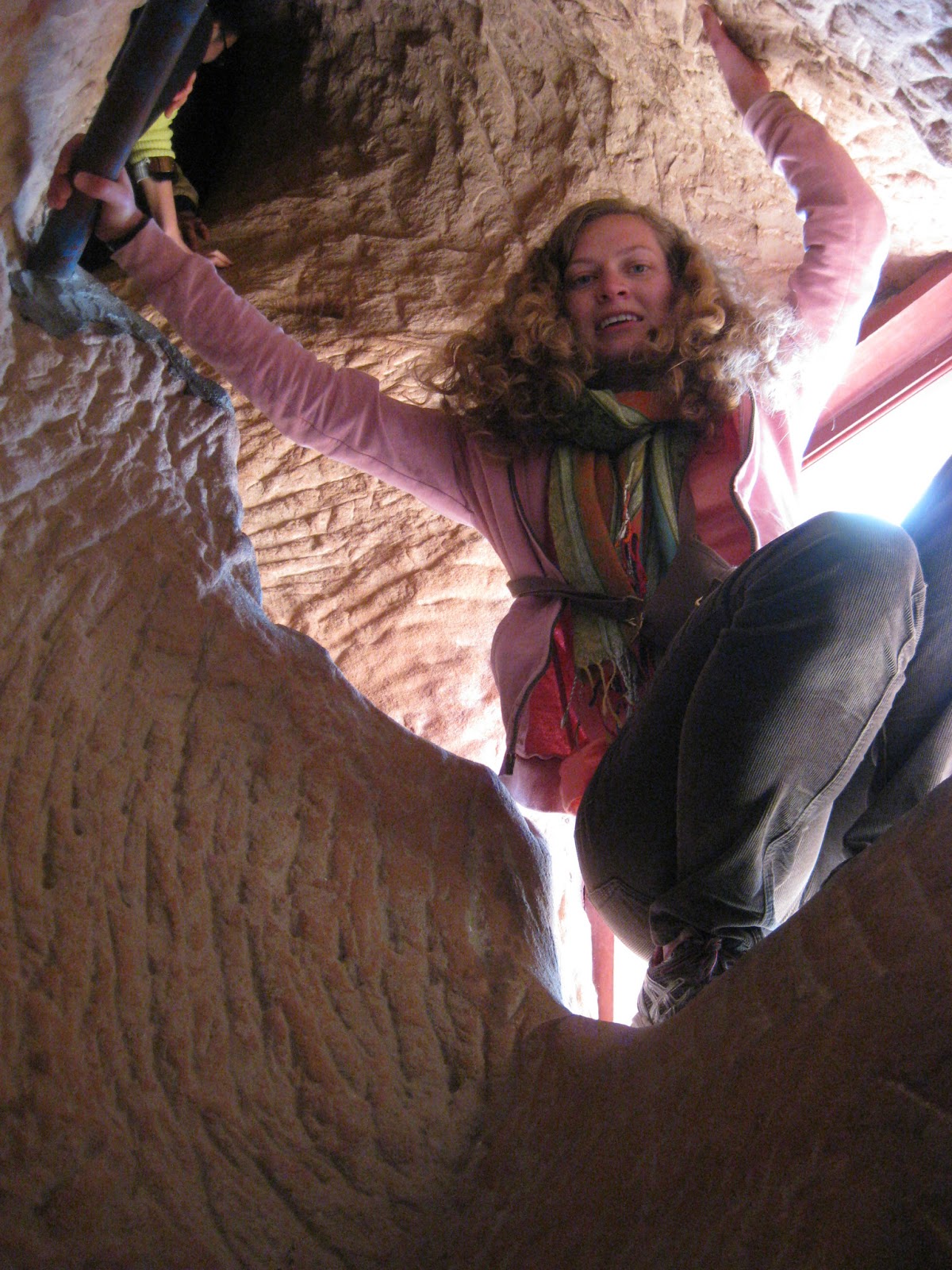
I stopped at a second, smaller temple on the way back to Zhangye.  It was smaller but had its share of surprises, including the section where the monks had decided not to build stairs but instead just carved handholds into a vertical chute.  I knew my rock climbing past would be useful eventually! 
About to descend the vertical tunnel
After a quick street food snack in Zhangye, I checked out the largest clay indoor sleeping Buddha in China.  Every town or city wants to have the biggest Buddha, and after they add in all those qualifiers, I guess they can have the biggest of one very specific kind of Buddha, but they all look pretty similar to me, and after seeing the actual largest Buddha in the world in Leshan, Zhangye's sleeping Buddha was only mildly interesting.
My trip to Zhangye was a whirlwind tour.  Gansu province and Zhangye definitely deserve more time, and hopefully I'll be back someday. 


Fairy Land

A few months ago, my friend Katie sent me this link along with a short message: "You could go here, if you wanted." I immediately googled Zhangye and found out that it's in Gansu province in Western China, far away from me and anything else.  It is very far off the beaten track, so far that at first it seemed impossible to reach, and my trusty Lonely Planet actually failed to mention Zhangye's Danxia park.  I bookmarked the page but forgot about it.  With a five day holiday the first week of April, I started to think about where I would like to travel and I revisited Zhangye.  I checked the train schedule and found out I could get there easily enough by a 17-hour train and then a 6-hour train.  As soon as I thought of it, I couldn't get Zhangye out of my mind, so last Thursday afternoon I found myself on a sleeper train speeding west. 
There's something thrilling and magical about long train rides.  Every time I get on a train or bus to somewhere new, no matter how long and arduous the journey might be, I feel so adventurous and excited and happy that the hours seem to melt away.  The next morning I arrived in the capital of Gansu province and caught my train to Zhangye.
First stop in Zhangye was the Danxia mountains from the link.  Luckily I ran into a German couple in the lobby of my hotel, and we split the cost of a taxi.  Once in the park, we had to ride a shuttle bus to four viewing points, where we could wander along several paths. Unfortunately, they were quite strict about that, and we weren't allowed to wander off on our own.


A self-timed Danxia Titanic moment that I ruined by looking back at the camera at just the wrong moment
 Despite reading it several times, I still can't really remember how these formations came to be.  It has something to do with mineral deposits and mysterious happenings beneath the Earth's crust. Anyway the result is spectacular and strange.  I had read that the Zhangye Danxia felt like something out of a fairy tale or even another planet. The entire park was treeless, in fact it seemed devoid of all animal and plant life other than the handful of tourists and two camels for us to take pictures with. 

Good Advice, bad English


When have I ever let a sign like this stop me?
Zhangye's Danxia park truly did feel like something out of a fairy tale or a surrealist painting, and without a doubt it was worth the 24-hours of train time. 

Monday, April 8, 2013

April Fool's Day and Duck Duck Goose

Last week I had a short but action packed week at school.  April 4th was Tomb Sweeping Day, a holiday similar to Memorial Day, so we had an extra long weekend.  Since it was a short week, and it coincided with April Fool's Day, I made the week an extra special one for my students.

On Monday, I decided to play a trick on my students and co-teachers.  A few weeks ago, I impulsively bought this blue wig at a market in Beijing, and it came to mind when I was planning an April Fool's prank on my students.

After braiding and pinning my hair, it just barely fit under the wig.  I wanted to get to the teacher's office before class without anyone seeing me, so I walked outside the school building and up the opposite staircase, rather than passing all of the classrooms like I normally would.  A few students did see me on the way to the office and I got a few shrieks of surprise and lots of double takes.  I hadn't mentioned my trick to the other teachers, so when I walked into the office they were also surprised and one of them even thought it was my real hair.    Word spread pretty quickly that I was playing this joke, because lots of teachers that I don't even know came to look at me (these weren't English teachers, so they couldn't even talk to me), and tons of students tried coming into the office to see my hair.  When I got to my first class, the students started clapping and laughing and cheering.  I repeated the trick for all of my morning classes before lending the wig to my friend Alex to so that she could play the same joke on her university class. Chinese people also celebrate April Fool's Day.  My friend Ada told me that middle school boys will often write notes to girls they like, and if the girl likes them back, then they're happy, but if the girl doesn't like them back, they just pretend it was an April Fool's joke.  And, apparently, students often play jokes on their teachers by telling the teacher that they've come to the wrong class until the teacher gets confused and leaves. 
My students loved my blue wig, but they loved the camera even more


On Wednesday, most of my students left early to spend the holiday with their families.  I only had to teach one class and it was a beautiful day, so I decided to take my class outside to play games.  It was a first grade class with a very low English level, but I thought that they could handle games like London Bridge, Duck Duck Goose and Red Light Green Light.  I thought wrong.  They were so excited to be outside and with me that they couldn't settle down long enough to learn the rules to any of these games.  So mostly we just ran around and laughed.
Playing London Bridge
My class didn't really understand the concept of any of these games.  Rather than sitting in a nice circle to play duck duck goose, they all jumped up and down and shouted "Me! Me!" while whoever was "it" wandered around indecisively.  Then, without saying either "duck" or "goose," they would tag one of their friends and run crazily away until they felt like sitting down.  I tried uploading a video of this but for whatever reason it's not working.  As I said, we had fun playing outside, but I don't think I'll be repeating it anytime soon.

Friday, March 29, 2013

Hanging Temple and Yungang Grottoes

Over my long weekend, my parents and I headed to the little known city of Datong in nearby Shanxi province.  We took and overnight train, which was another new experience for Mom and Dad, but pretty familiar for me by now.  Although usually it is a bad idea to listen to anyone offering taxis, hotels or tours outside the train station, I had done my research and knew that CITS, a large and reliable travel agency in China, often sent someone to wait for tourists at the train stations.  Since we had a limited time in Datong and the few sights we wanted to see were all a long drive away, we decided to go to the CITS office to see what they could offer us.  They called an English speaking driver for the day, and we were off.
First stop, the Hanging Temple.
The temple, built into the cliffside, is about an hour's drive away from Datong through rural Shanxi.  The area is very poor.  Most people are either subsistence farmers or coal miners.  The scenery along the way was beautiful, with jagged cliffs and hills, but peppered with rundown villages and cave homes.  It's definitely a far cry from the bright lights and wide avenues of Wangfujing, where my parents had stayed in Beijing.
The temple itself isn't too well known.  Although Datong is in the process of becoming a tourist destination (the center of the city was recently torn down to build a replica of the "old city" that used to be there), it hasn't really caught on yet.  There were a few other tourists at the temple, but not too many. 


Did I mention my mom is afraid of heights?  I'm not sure I still believe that, after the Great Wall and climbing up into the Hanging Temple.  I think the ski jump is next! 
We climbed up to the temple and walked through it, which didn't take very long.  It's pretty small, which makes sense considering how much work it must have taken to build it into the cliff.  Even so, it was one of the highlights of my parents' visit to China, and one of my favorite trips as well.
After seeing the Hanging Temple, we stopped for lunch with our driver and continued on to the Yungang Buddhist Grottoes, another hour's drive away. These grottoes, with over 50,000 statues, were carved 1,500 years ago.  They were really impressive, even though all three of us have an admitted ignorance about Buddhism and didn't know the significance of anything. 
I'm having internet problems right now, and it has suddenly decided not to let me upload any more photos, so you'll just have imagine the Yungang Grottoes for now.  Or Google them, I guess.

Visiting Dignitaries

Last week my parents were visiting China, and after a few days exploring Beijing and the Great Wall, they came down to Baoding and the Eastern Bilingual School.  They definitely got the royal treatment at school.  As when Elizabeth and Ben came in January, my students were so excited to see my parents that I was almost invisible to them.  I'm used to getting cheers and hugs when I enter a classroom, but my family all got more hugs and cheers than I ever did, and small gifts as well.  One girl gave my mom a tiny fake pearl. 
Entirely by chance, one of the days my parents were here was my school's annual kite flying festival.  The whole primary school, kindergarten, and the parents of the first grade were all gathered to open  the festival with a few speeches, the national anthem and a brief kite display.  After I met my parents at the school gate, we went out to the field to watch the proceedings.  I thought we could watch from the back of the crowd, but one of the teachers approached us and asked us to sit in front, facing the crowd, with the most important people from our school.  So, as the festival began, we sat facing over a thousand children, parents and teachers, and were announced alongside the principal, headmaster, and founder of the school.  Yeah, apparently foreign teacher (and parents!) is just as important as founder around here.  And, not to brag, but I did get the biggest cheer from the students.
The view from our seat

Some of the older students opening the festivities
After the flag raising and opening speeches, the older students went back to class, and even though I was supposed to have class, too, the school photographer wanted to take some pictures of us with the students and the kites.  First he had us link arms with some sixth graders and walk around looking at the different kites that students had decorated.  I don't teach sixth grade, so the students were a little shy about talking to me. 
Each student had a blank kite to decorate with their hopes and dreams
Of course, after all of the older students returned to class, we were asked to be in class photos of all six first grade classes, and some parents even asked me to take individual pictures with their students.  My face hurt from smiling so much!  I don't interact with my students' parents very often, obviously because I can't speak Chinese, so it was nice to meet some of them and for them to see their children speaking English with me and my parents.  By the way, the Chinese equivalent of "cheese" when taking a picture is "qiezi," the word for eggplant, because like the word cheese, it forces the speaker's mouth into a smile.

One of my first grade classes with their kites
After all of the pictures, we followed the students and their parents out to the field where we all flew kites and ran around for a while.
After the kite flying festivities, the rest of my parents' visit to Baoding was pretty tame, although we did go to all of my favorite restaurants and spend time with my American and Chinese friends before leaving for a weekend trip to Datong. 

Wednesday, March 27, 2013

Fear of Heights

I'm not the one who's scared of heights.  That's my mom.  And no, even though I knew about the chair lift and alpine slide at the Mutianyu section of the Great Wall, I didn't mention it until we got there. 
This was another first for me as well.  I don't know what the section I went to in the fall is called.  It was billed by my hostel as "Secret Great Wall," and it did seem pretty secret as there were very few people there.  However, I'd heard many good things about the Mutianyu section, so that's where I decided to take my parents. 
Upon arrival, we had to take a chair lift up from the parking lot to the wall.  There, we had a choice of which way to hike and of course we chose the unrestored section, and completely ignored the "not open to public" sign.  To be fair, lots of other people ignored it too.
The restored section, with the now familiar smog

Our path


After walking as far as we could along the unrestored part of the wall, we headed back to our starting point, where our options to return to the parking lot and our driver were either the chair lift back down or an alpine slide.
Which do you think we chose?

We couldn't pass up the chance to take an alpine slide, after all.

Despite a bit of smog, we had a lovely day at the Great Wall.  I know that the Wall inspired thoughts of grandeur and, well, greatness, but actually I'm much more inspired and awed by the sections that are so crumbled and old that it is barely recognizable as a wall at all.  I think my parents felt the same way.  After all, we share a devotion to Antiques Roadshow and American Pickers, and always take their lessons to heart.  Don't restore anything, don't repaint anything, don't fix anything.  It's a lesson China could try to learn.