Sunday, May 19, 2013

Fine Dining

Many foreign travelers to China make the mistake of skipping Hebei Province in favor of the more glamorous Beijing and Shanghai.  This is a mistake.  Hebei, and Baoding in particular, is one of China's hidden gems.  It is home to stunning natural scenery, top-notch international cuisine, and authentic Chinese cultural experiences.  It would be a mistake not to consider visiting Baoding on your next trip to China.  This post is the first in a three part series about Baoding's charms.  I'll focus on food and restaurants today, and in the future I'll introduce you to the other wonderful things that Baoding has to offer.  There are many many wonderful restaurants in Baoding, but I'll just list my top eight favorites here.

8. Dumpling place.  This hole-in-the-wall dumpling restaurant is great for a quick lunch.  The dumplings are simple and delicious and cheap.  For 8-20 kuai you get a plate of 25 dumplings.  The owner and staff are friendly and spent several minutes comparing my friends to various movie stars.  The owner also gave my friend a free haircut right there in the restaurant, that you can read about here  If this restaurant has a name, I don't know it.  It's down an alley near Hebei University Old campus. 
.

7. Jin Jiaozi.  Jin Jiaozi, or Golden Dumplings, is home to a wide variety of dumplings, including my personal favorite tomato and egg.  The picture menu includes many other typical northern Chinese dishes, but the dumplings are the real star here.  It's located on the eastern side of Military Square.

6. Polaris Garden.  Despite the fact that I saw a rat running along the ceiling last time I went to Polaris Garden, it still makes my top 8 list.  The owner of this cafe is friendly and speaks perfect English. The food is a good approximation of real Western food, and cheaper than Pizza Hut or similar options.  Foreigners often get a discount, especially if they go here often.  The pizza and coffee are good, but the atmosphere is the real draw.  It's located on Heng Xing North St, near a bus stop for 17 and 37. 

5. Muslim Noodle Restaurant.  Across from the dumpling place I mentioned earlier, this restaurant serves freshly made Muslim noodles with various toppings.  I usually order off the large picture menu on the wall. They make the noodles fresh all day long. 


4. Tree Corner House.

For the best pizza in Baoding (and in my personal opinion, all of China), go to Tree Corner House.  The owner used to be the cook at Polaris, but now he's opened his own restaurant.  He's passionate about pizza and other western food.  The pizza here approximates what you might find at home in the US.  For now, the menu is only in Chinese, but the owner speaks some English and will help you order if you ask.  You can get here by bus 22, 33, 305 or 306, it's on Hengxiang St, between Wusi St and Dongfeng St, and it's easy to spot. 

3. QLH.  This is a cafe, not a restaurant.  They serve coffee and ice cream.  There are two branches in town, one near the Agricultural University, the other off of Military Square.  Both are gathering places for expats and Chinese students practicing English.  The coffee and ice cream is very cheap and solidly mediocre, but the atmosphere is great and the internet is free and fast.  It's a great place to spend an afternoon and to meet people.


2. The Korean Restaurant. As with many restaurants on this list, our favorite Korean restaurant is very cheap.  I actually never had Korean food before I came to China, and I've never been to Korea, so I can't say for sure how authentic it is,  but a friend of mine lived in Korea last summer, and she loves this restaurant.  It's just down the street from Tree Corner House, and it has a compact but delicious picture menu.


1. The Old Cook.  I won't lie to you, this restaurant tops the list for sentimental reasons.  It has been home base for generations of Hebei University teachers, which is how I found out about it.  It is the basis for my taste in Chinese food, and while there are probably better versions of Gong Bao Ji Ding, Wan Cai and Tu Dou Pian, I always compare them to the Old Cook.  Much like I will always prefer my mother's cooking to any imitators, The Old Cook will always be my standard for Chinese food.  There is an extensive picture menu.  The Old Cook is on WuSi Lu, across from Globe Square.  Buses 17 and 22 stop here.


Thursday, May 9, 2013

This Week

Here's some things that happened to me this week:

I was asked to perform "My Heart Will Go On" with 10 of my students in front of the whole school at the Children's Day assembly in a few weeks. 

My friend Ada returned from her honeymoon to Hainan.  A few weeks ago when I asked her about her wedding, she said she was calm about the wedding itself, but excited for her life after it, which I think is the best possible way to feel about marriage and I'm really happy for her.

I'm teaching my students about the planets and space.  I asked my fifth graders what their favorite planet was, and one girl told me that Earth was her favorite because it has food.  She also told me she didn't want to go to the moon because it has no food.

I finished reading Red Sorghum, a book by the Chinese Nobel Prize winning author Mo Yan.  It was incredible and beautiful and taught me a lot about Chinese history but also reminded me how little I know about Chinese history even after living here for so long.

On Monday I went to the post office to send a graduation gift to some of my favorite Carls.  I love going to the post office, because the lady who works there is so friendly.  The first time I went there in October, it was obvious that she had never met a foreigner before, and I think she probably had never sent mail internationally.  Also, there was a very very big language barrier at that time, so all I could really do was repeat "meiguo" (America) over and over while pointing at a pile of postcards.  Now, she's used to me and it seems like she's happy to see me, which is all I can really ask for.

For some reason our school installed security cameras all over campus, including three in the first grade hallway and one in the hallway where my apartment is.  It's vaguely unsettling.


Sunday, May 5, 2013

Sports Day!

It's already summer here in Baoding.  Spring was here and gone while the Midwest was still blanketed with snow and ice.  My school celebrated the warm sunny weather by having a sports day last Monday.  Classes were canceled and the whole school participated in games and races all morning long before going home for the May Day holiday.
The festivities opened with a ceremony to rival the Olympic Opening Ceremony.  Each class marched in together with a unique banner and chant.  My American co-worker and I were informed on the spot that we had to score the classes in six different categories as they walked in.  By now we're not even surprised anymore when we get last minute news like this, so we followed our friend and co-teacher Miss Bi up to the head table, where she attempted to translate the score cards.
The students all took this very seriously.  I waved and smiled to a few of my students, but only the 1st graders smiled back.  The older students kept their concentration and ignored me.  After all of the classes had marched in and assembled, they raised the Chinese flag, sang the national anthem, and did a set of exercises in unison.
Finally it was time for the games to begin.  The first event was a hundred meter dash.  The fifth and sixth graders were mixed in every heat, so I was very proud when some of my fifth graders placed in the top three and won prizes.  After the 100, each grade split off to play games together.  The other American teacher and I went around to each grade and played games such as tug-of-war, a three legged race, and various relay-type races.  
And now, because I am entirely at the mercy of the Chinese internet, I will post this without pictures. 

Thursday, April 18, 2013

Mei Ban Fa

My friend Jess's favorite Chinese phrase is mei ban fa.  It means "my hands are tied," or  "it can't be done."  This is the perfect phrase to describe my work as an English teacher.
I have been planning this blog post in my head ever since I arrived in China and started thinking about the Chinese education system, but I wanted it to be perfect which is what has taken so long.  There is so much I want to say about how education works here and how it works at home, and how the two systems are both kind of broken and could both learn a lot from each other.  I just want to say, as a disclaimer, these are all my own opinions, based on my experience here and conversations I've had with Chinese and foreign teachers, and not necessarily the experience of every Chinese student and teacher. 
The first thing you need to understand about the Chinese education system is that it is test based.  Students must pass exams to enter each level of school, and their scores on these exams can determine their future.  Unlike in the US, Chinese students are accepted to university (and middle school, and high school) based entirely on their test scores.  There is no interview, no essay, no consideration of extracurriculars or part-time jobs.  Time spent on sports teams or art or dance is considered a waste of time by many, unlike in the US where extracurricular activities are coveted collector items.   Exams determine which students go to the best middle schools and high schools and universities, and much like in the US, students from the best universities have the best job opportunities later.  And when you are one of 1.3 billion people, every advantage you can get to stand out is desperately sought after.  The result of this system is a lot of stress on students, even very young students like my first and second graders. 
There are other things at play here.  The exam system is only the most obvious manifestation of a system that values memorization and correct answers over creativity and individuality.  Chinese students are expected to be quiet and well-behaved.  They don't like to volunteer answers in class if they might be wrong.  They are not taught to ask why and they are not asked open-ended questions with multiple right answers.
 In one of the many conversations about education I've had with my friend and co-teacher, Ada, she lamented the lack of creativity in Chinese students.  She said that everyone from teachers to government officials wants Chinese students to be more creative, but that none of them know how to teach creativity and innovation.  While in the US teachers and parents and news organizations lament the US's low test scores, Chinese teachers wonder how they can make their classroom more creative and open-minded.  While the US cuts funding for art, music and drama programs, teachers and officials in China worry that their students don't know how to be innovative.  They know that China is good at producing things, but they worry that all of the ideas are still coming from the US and Europe. It's a classic case of the grass is always greener.  We want China's super high test scores in math and science.  They want our creativity.
Some of my second graders performing "The Three Little Pigs"
 When I started teaching in September, I had no idea what I was doing.  Other than an online TEFL course and a few hours of observation, I didn't know anything about teaching.  At first all I wanted was to keep the students somewhat engaged or interested, but after I had a few conversations with Ada about the limitations and faults of the education system, my goals for my classes changed.  I got into a heated argument with the other foreign teacher at our school about our purpose.  He maintained that we were foreign showpieces for the school to attract new students, and that although the students benefited from a native English speaker, the odds were against us having any real impact on our students.  I stubbornly disagreed, despite the fact that our school does treat us that way.
What can I teach my 1000+ students?  How can I encourage them to speak English, to make mistakes and learn from them, when they are used to being quiet and correct?  How can I teach them that they are all unique, creative, wonderful individuals?  How can I impress on them that they have so much more to learn from studying English than whatever they need to pass their exams?  The real answer, I guess, is mei ban fa, there's nothing I can do.  My students will have all of the stress of multiple rounds of exams and schooling.  Some of them will continue to study English, more will not.  I know that as long as my students have teachers who think and talk about different ways of teaching and learning, like Ada and the other teachers at my school, they will succeed in the education system.  All I can really hope that my students learn from me is to laugh and enjoy learning and to love people who are very different from them.  I know that  I've at least succeeded in the last one.  My students, like children everywhere, are very ready to love.


Tuesday, April 9, 2013

Once you see one cliffside temple...

It turns out that once you see one temple built precariously into a cliff-side, you will spend your entire life seeking out others like it.  Not really.  I actually planned on skipping Mati Si near Zhangye to save money and time, because I had already seen the Hanging Temple near Datong a few weeks ago with my parents.  But when the German couple I had met up with mentioned they were going to Mati Si the next day, I decided to tag along. 
Mati Si
Tibetan prayer flags in front of a snow covered mountain
As with the Hanging Temple in Datong, I have no idea why anyone chose to build a temple in such a strange and dangerous place.  But that's where the similarities end, and I'm so glad I got to see both.  Mati Si is more cave-like and built into the cliff itself. The largest section has five distinct floors connected by tunnels and staircases.  Eact floor had several rooms for prayer, and of course a beautiful view.

Mati Si (Horse Hoof Temple) is named after a hoof print left by a fairy horse.  I don't know how the builders of the temple knew it was a fairy horse and not a real horse, but I guess I'll just take their word for it.  Mati Si was breathtaking, and one of the best parts was that we had it nearly to ourselves.  When we arrived, there was only one other car in the parking lot, and by the time we left we had seen no more then ten other tourists.  In China it often seems impossible to escape the crowds, so the solitude was a big plus for Mati Si. 
After walking through the first temple, I hiked up the hill behind it for some spectacular views.
 

The surrounding hills, dotted with grottoes
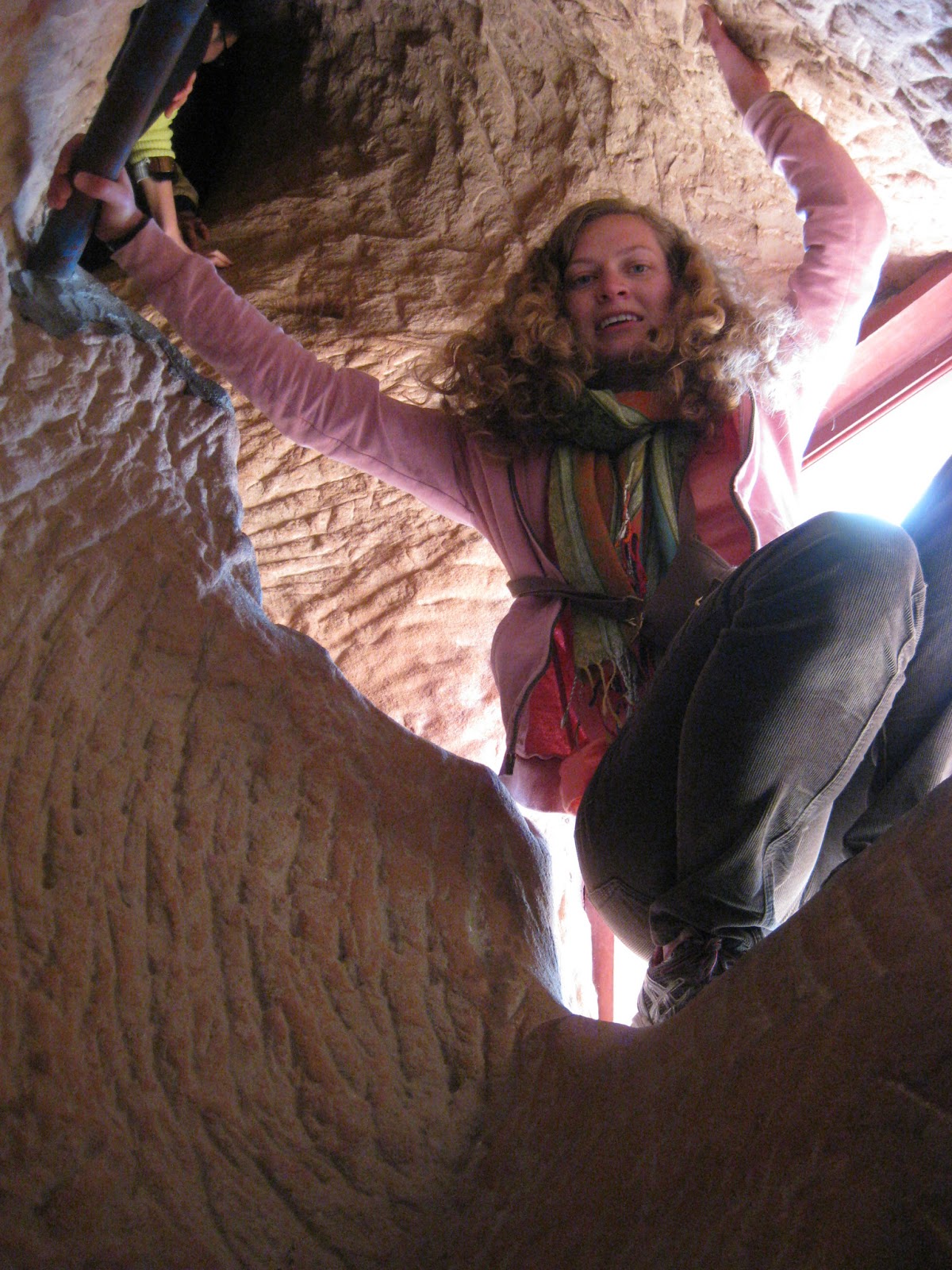
I stopped at a second, smaller temple on the way back to Zhangye.  It was smaller but had its share of surprises, including the section where the monks had decided not to build stairs but instead just carved handholds into a vertical chute.  I knew my rock climbing past would be useful eventually! 
About to descend the vertical tunnel
After a quick street food snack in Zhangye, I checked out the largest clay indoor sleeping Buddha in China.  Every town or city wants to have the biggest Buddha, and after they add in all those qualifiers, I guess they can have the biggest of one very specific kind of Buddha, but they all look pretty similar to me, and after seeing the actual largest Buddha in the world in Leshan, Zhangye's sleeping Buddha was only mildly interesting.
My trip to Zhangye was a whirlwind tour.  Gansu province and Zhangye definitely deserve more time, and hopefully I'll be back someday. 


Fairy Land

A few months ago, my friend Katie sent me this link along with a short message: "You could go here, if you wanted." I immediately googled Zhangye and found out that it's in Gansu province in Western China, far away from me and anything else.  It is very far off the beaten track, so far that at first it seemed impossible to reach, and my trusty Lonely Planet actually failed to mention Zhangye's Danxia park.  I bookmarked the page but forgot about it.  With a five day holiday the first week of April, I started to think about where I would like to travel and I revisited Zhangye.  I checked the train schedule and found out I could get there easily enough by a 17-hour train and then a 6-hour train.  As soon as I thought of it, I couldn't get Zhangye out of my mind, so last Thursday afternoon I found myself on a sleeper train speeding west. 
There's something thrilling and magical about long train rides.  Every time I get on a train or bus to somewhere new, no matter how long and arduous the journey might be, I feel so adventurous and excited and happy that the hours seem to melt away.  The next morning I arrived in the capital of Gansu province and caught my train to Zhangye.
First stop in Zhangye was the Danxia mountains from the link.  Luckily I ran into a German couple in the lobby of my hotel, and we split the cost of a taxi.  Once in the park, we had to ride a shuttle bus to four viewing points, where we could wander along several paths. Unfortunately, they were quite strict about that, and we weren't allowed to wander off on our own.


A self-timed Danxia Titanic moment that I ruined by looking back at the camera at just the wrong moment
 Despite reading it several times, I still can't really remember how these formations came to be.  It has something to do with mineral deposits and mysterious happenings beneath the Earth's crust. Anyway the result is spectacular and strange.  I had read that the Zhangye Danxia felt like something out of a fairy tale or even another planet. The entire park was treeless, in fact it seemed devoid of all animal and plant life other than the handful of tourists and two camels for us to take pictures with. 

Good Advice, bad English


When have I ever let a sign like this stop me?
Zhangye's Danxia park truly did feel like something out of a fairy tale or a surrealist painting, and without a doubt it was worth the 24-hours of train time. 

Monday, April 8, 2013

April Fool's Day and Duck Duck Goose

Last week I had a short but action packed week at school.  April 4th was Tomb Sweeping Day, a holiday similar to Memorial Day, so we had an extra long weekend.  Since it was a short week, and it coincided with April Fool's Day, I made the week an extra special one for my students.

On Monday, I decided to play a trick on my students and co-teachers.  A few weeks ago, I impulsively bought this blue wig at a market in Beijing, and it came to mind when I was planning an April Fool's prank on my students.

After braiding and pinning my hair, it just barely fit under the wig.  I wanted to get to the teacher's office before class without anyone seeing me, so I walked outside the school building and up the opposite staircase, rather than passing all of the classrooms like I normally would.  A few students did see me on the way to the office and I got a few shrieks of surprise and lots of double takes.  I hadn't mentioned my trick to the other teachers, so when I walked into the office they were also surprised and one of them even thought it was my real hair.    Word spread pretty quickly that I was playing this joke, because lots of teachers that I don't even know came to look at me (these weren't English teachers, so they couldn't even talk to me), and tons of students tried coming into the office to see my hair.  When I got to my first class, the students started clapping and laughing and cheering.  I repeated the trick for all of my morning classes before lending the wig to my friend Alex to so that she could play the same joke on her university class. Chinese people also celebrate April Fool's Day.  My friend Ada told me that middle school boys will often write notes to girls they like, and if the girl likes them back, then they're happy, but if the girl doesn't like them back, they just pretend it was an April Fool's joke.  And, apparently, students often play jokes on their teachers by telling the teacher that they've come to the wrong class until the teacher gets confused and leaves. 
My students loved my blue wig, but they loved the camera even more


On Wednesday, most of my students left early to spend the holiday with their families.  I only had to teach one class and it was a beautiful day, so I decided to take my class outside to play games.  It was a first grade class with a very low English level, but I thought that they could handle games like London Bridge, Duck Duck Goose and Red Light Green Light.  I thought wrong.  They were so excited to be outside and with me that they couldn't settle down long enough to learn the rules to any of these games.  So mostly we just ran around and laughed.
Playing London Bridge
My class didn't really understand the concept of any of these games.  Rather than sitting in a nice circle to play duck duck goose, they all jumped up and down and shouted "Me! Me!" while whoever was "it" wandered around indecisively.  Then, without saying either "duck" or "goose," they would tag one of their friends and run crazily away until they felt like sitting down.  I tried uploading a video of this but for whatever reason it's not working.  As I said, we had fun playing outside, but I don't think I'll be repeating it anytime soon.